
Key Account vs Retail Rates: How UAE Businesses Save up to 65%
Your business could be overpaying for international shipping by up to 65%. The reason is not your destination or package weight—it is the rate card you are using. For small and medium-sized enterprises (SMEs) in the UAE, the gap between standard retail pricing and negotiated Key Account pricing represents one of the single largest opportunities for cost savings in the entire supply chain. Yet, most businesses believe these rates are reserved for multinational corporations.
This is no longer true. The UAE's courier, express, and parcel (CEP) market is projected to grow at a 7.52% CAGR through 2031, with international lanes expanding even faster, according to Mordor Intelligence. In this competitive landscape, understanding how to access better express shipping rates in Dubai is critical. This guide breaks down the difference between retail and Key Account rates and explains how your business can gain access to enterprise-level discounts, regardless of your shipping volume.
Why Retail Express Rates Are So High
For any business shipping internationally from the UAE without a negotiated contract, the costs can feel unpredictable and excessively high. This is by design. Retail rates are structured to cover the highest possible operational costs for the carrier, factoring in uncertainty and low volume. There are three primary drivers behind these inflated prices.
The Problem with Published 'List' Rates
When you walk into a carrier's service centre or use their online portal for a one-off shipment, you are quoted the 'list' or 'retail' rate. This is the highest possible price for that service.
For example, DHL's 2025 UAE retail rate guide shows a 19 kg export shipment to Europe (Zone 7) costs AED 8,305.01 at the published tariff, according to the official carrier guide. Similarly, FedEx's 2025 retail tariffs for International Priority® exports from the UAE can have minimum charges of AED 367 per shipment, even before the weight-based cost is calculated.
These list rates are intentionally high because they serve individual consumers and infrequent business shippers who provide no predictable volume. They are the baseline from which all discounts are calculated.
The Disadvantage of Low Volume Leverage
The core of logistics pricing is volume. Carriers reward loyalty and predictability. A business shipping 50 parcels a month has virtually no bargaining power and is treated as a retail customer. They cannot commit to the consistent volume that would justify a carrier investing time in creating a custom contract.
According to a report by OTO, the UAE's CEP market is fragmented, with the top five players holding only about 25.84% of the market share. While this fosters competition, it also means carriers focus their best pricing on high-volume accounts that help them secure that share. Without volume, an SME cannot access the tiered discounts that can reduce per-kilogram charges by 20-65%.
How Surcharges Inflate Your Final Bill
The base rate is only part of the story. The final invoice for retail shippers is often inflated by a series of surcharges that are non-negotiable at the retail level. These can add 15-40% to the total cost.
- Fuel Surcharges: A percentage of the transport charge, adjusted monthly.
- Peak/Demand Surcharges: Applied during busy seasons like Q4 or major holidays.
- Remote Area Surcharges: For deliveries outside major metropolitan hubs.
- Additional Handling Surcharges (AHS): For packages that are oversized, overweight, or have non-standard packaging.
FedEx UAE, for instance, publishes tiered surcharges that can be significant. A 'Tier C' surcharge can be the greater of AED 130 per shipment or AED 2.4 per kg, as detailed on their official rates page. For a 20 kg shipment, this could add a minimum of AED 130 before any other fees. Retail customers absorb these costs in full.
What 'Key Account' Pricing Actually Is
Key Account pricing is a commercial structure reserved for a carrier's most valuable clients. It moves a business from paying unpredictable retail rates to a stable, discounted contract. This is the tier where businesses find cheaper courier rates in Dubai and achieve significant savings.
A Definition: Contract vs. Retail Tariffs
A Key Account rate is a contracted, volume-based tariff offered by carriers like DHL, FedEx, and UPS to businesses that commit to a certain level of monthly or annual shipping spend. Instead of paying the public list price, the business receives a unique rate card with built-in discounts. This structure provides cost predictability and is the foundation of a strategic logistics partnership.
This is the core of the Infinity Logistics model. As a DHL, FedEx & UPS Key Account Centre, we provide our clients with these pre-negotiated contract rates, offering savings of up to 65% below retail.
The Mechanics of Carrier Volume Tiers
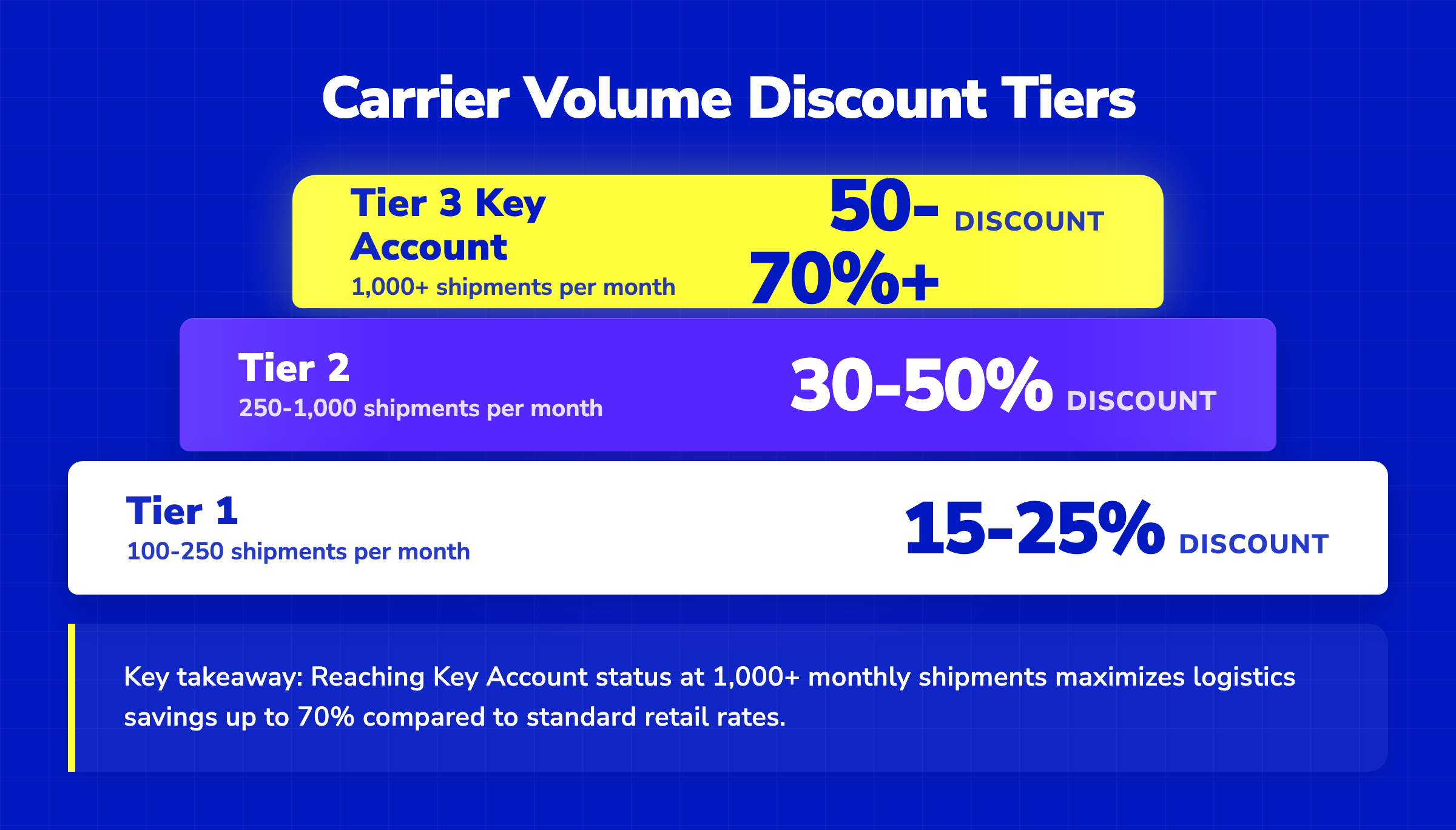
Carriers organise their business customers into tiers based on shipping volume or total spend. A typical structure might look like this:
- Tier 1 (Entry-Level Business): 100-250 shipments/month. Receives a modest discount (e.g., 15-25%) off retail.
- Tier 2 (Mid-Volume): 250-1,000 shipments/month. Receives a significant discount (e.g., 30-50%).
- Tier 3 (Key Account/Enterprise): 1,000+ shipments/month. Receives the deepest discounts (e.g., 50-70%+) and dedicated support.
DHL MENA actively markets this model, offering SMEs savings of "up to 60%" as their volume grows on a direct business account, as noted on their SME portal. The challenge for most SMEs is that their individual volume rarely qualifies them for the highest tiers.
How Discounts Are Earned: Volume, Lanes, and Service Mix
Securing key account rates in the UAE is not just about total shipment count. The depth of the discount is influenced by several factors:
- Lane Concentration: Consistently shipping to specific regions (e.g., UAE to KSA, UAE to Europe) allows carriers to optimise their network and offer better rates for those lanes.
- Weight Profile: Businesses shipping heavier goods (e.g., 10-30 kg) are more sensitive to per-kilogram rates and can negotiate better terms than those shipping only light documents.
- Service Mix: A commitment to using a mix of a carrier's services (e.g., Express, Economy, Freight) can also lead to better overall pricing.
How SMEs Access Key Account Rates Without the Volume
The critical question for most UAE businesses is: how can we get these enterprise-level discounts if we only ship 50, 100, or 200 parcels a month? The answer lies in a powerful logistics model: aggregation.
The Power of Aggregation: A Shared Volume Model
An aggregator, or multi-carrier reseller, pools the shipping volumes of hundreds or thousands of SMEs into a single, massive account with carriers like DHL, FedEx, and UPS. Instead of negotiating with 500 individual small businesses, the carrier negotiates one master contract with the aggregator based on the enormous collective volume.
This model allows the aggregator to secure Tier 3 / Key Account pricing. They then pass these savings on to their individual SME clients. In essence, your 100 monthly shipments become part of a 10,000-shipment-per-month account, instantly giving you the buying power of a multinational corporation.
How Infinity Logistics Bridges the Gap for UAE Businesses
Infinity Logistics operates as a premier Key Account Centre, built on this aggregation model. We are one of the few UAE enterprises that is a Top-10 volume partner with DHL, FedEx, AND UPS simultaneously. This unique position allows us to command the highest discount tiers from each major carrier.
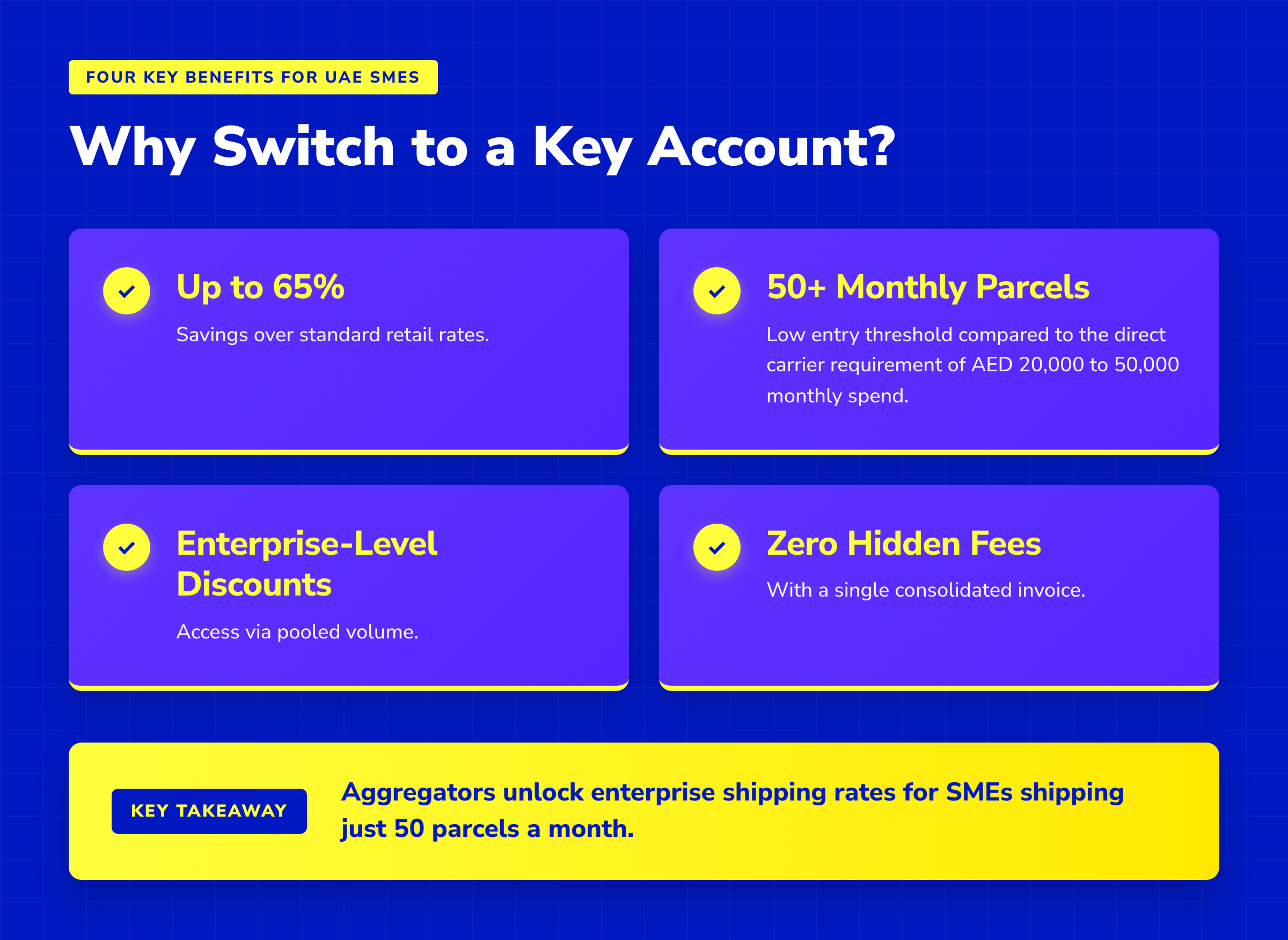
When a UAE business partners with us, they are not just getting a service; they are plugging directly into our aggregated volume. This is how we deliver express shipping rates in Dubai that are up to 65% below what a business would pay at retail, with no minimum volume commitment required from the client.
The Process: One Account, Multiple Carriers, One Invoice
Working with an aggregator simplifies the entire shipping process. Instead of managing multiple accounts, contracts, and invoices, the experience is streamlined.
The Infinity Process:
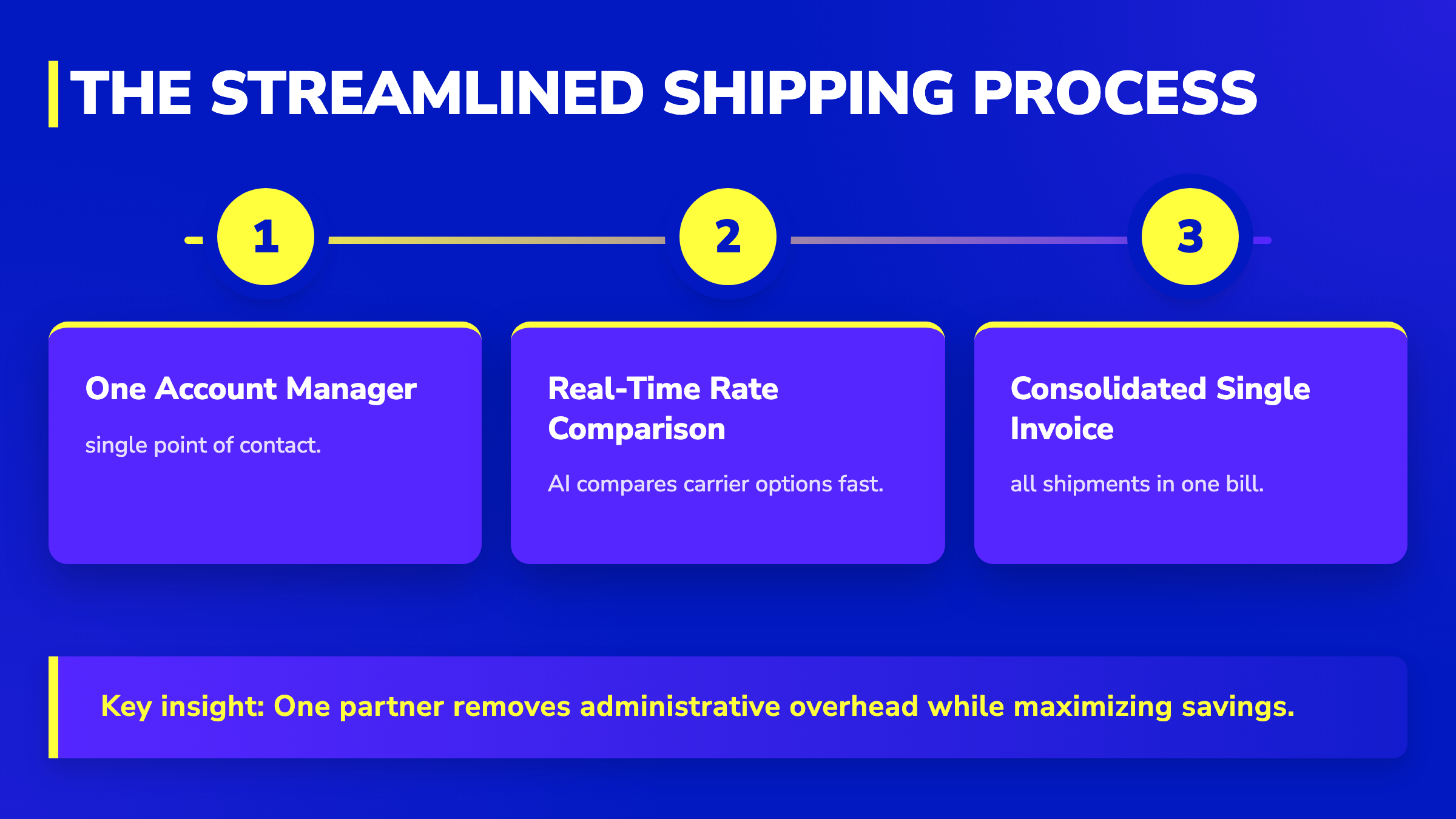
1. One Account Manager: You get a single point of contact for all your shipping needs, regardless of the carrier used.
2. Real-Time Rate Comparison: Our AI agents compare carrier options for your specific shipment in under 10 minutes, ensuring you always get the best available rate and transit time.
3. One Invoice: All your shipments across DHL, FedEx, and UPS are consolidated into a single, easy-to-understand weekly or monthly invoice.
This "One Account Manager. One Invoice. One Partner." approach removes administrative overhead while maximising cost savings.
Need a shipping quote?
Get AI-optimized rates from DHL, FedEx & UPS — up to 65% below retail. Quote in under 10 minutes.
What This Means Per Shipment: Illustrative Savings
The "up to 65%" saving is not a vague marketing claim; it is the direct result of a different pricing architecture. While exact savings vary, we can illustrate the impact with common scenarios for businesses shipping from the UAE.
Factors That Determine Your Savings
The precise saving on any given shipment depends on:
- Weight and Dimensions: Savings on minimum charges are significant for light parcels, while per-kilogram discounts matter more for heavier goods.
- Destination Zone: Discounts can be deeper on high-traffic lanes (e.g., to Europe or North America).
- Surcharge Profile: Avoiding or mitigating surcharges for remote areas or additional handling can account for a large portion of the savings.
Scenario 1: A Light Express Parcel to Europe (2 kg)
- Retail Rate Profile: The cost is dominated by a high minimum charge, which could be AED 160-250. With fuel and other fees, the total could easily reach AED 220.
- Infinity Key Account Profile: The negotiated minimum charge is significantly lower. The final cost, with mitigated surcharges, could be around AED 120.
- Per-Shipment Saving: ~45%
Scenario 2: A Medium B2B Shipment to the GCC (25 kg)
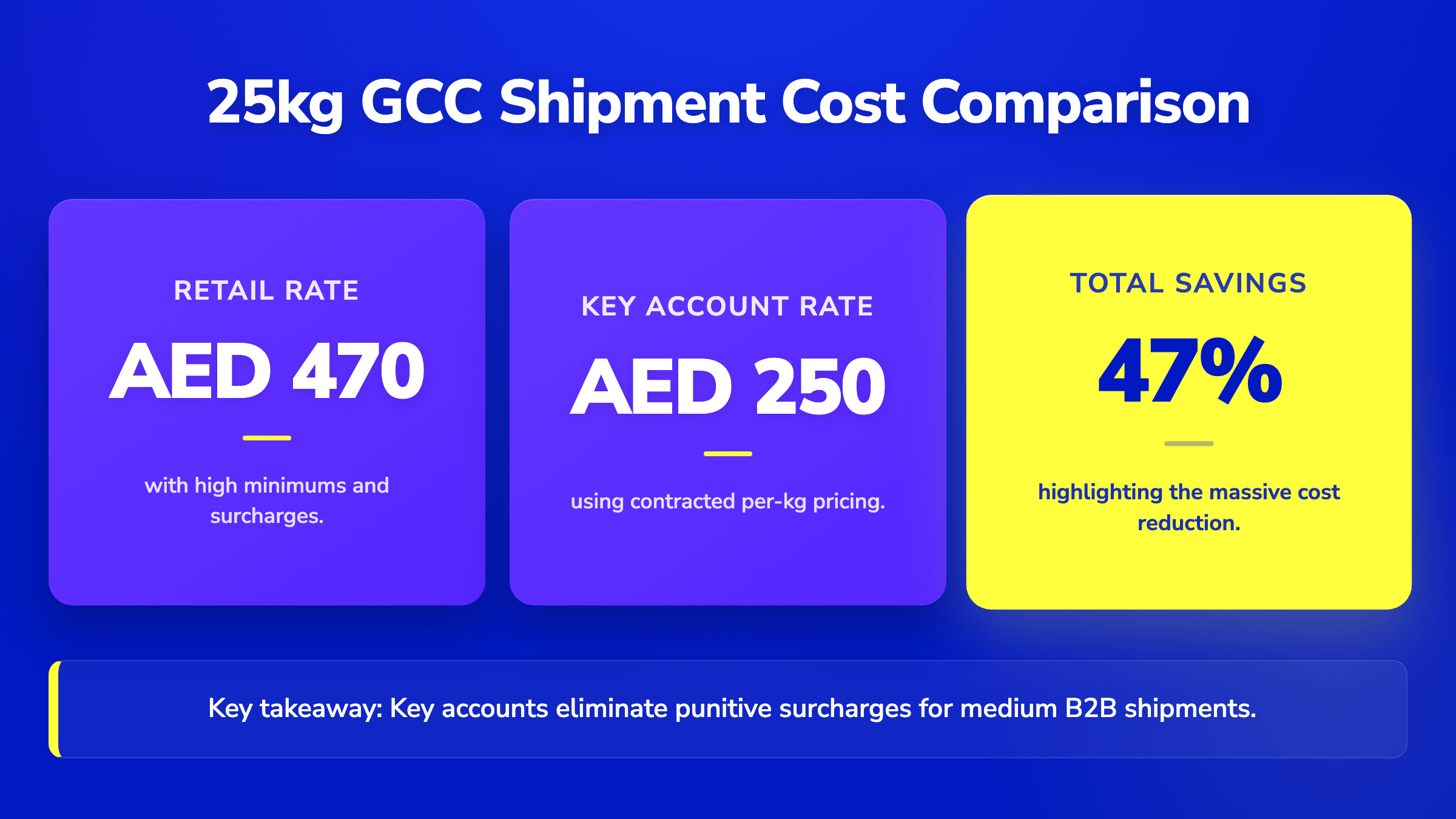
- Retail Rate Profile: This shipment would likely trigger a high minimum charge (e.g., AED 367) plus a potential weight surcharge of AED 100 or more. The total cost could be AED 470+.
- Infinity Key Account Profile: The shipment is priced on a lower, contracted per-kilogram rate, and the punitive surcharges are capped or eliminated. The total cost might be AED 250.
- Per-Shipment Saving: ~47%
The Scaled Impact: From Per-Box Savings to Annual Gains
These per-shipment savings quickly accumulate. For a business shipping 150 parcels a month, an average saving of AED 100 per parcel translates into AED 15,000 per month, or AED 180,000 per year. This is working capital that can be reinvested into growth, marketing, or product development.
The path to achieving cheaper courier rates in Dubai is not about shipping more; it is about shipping smarter. By leveraging an aggregated Key Account, your business can immediately access the pricing and benefits previously reserved for the largest players in the market. Ready to see what your rates could be? It takes less than 10 minutes to get a real-time quote and compare.
Frequently Asked Questions
What is the main difference between retail and key account shipping rates?
The main difference is the pricing structure. Retail rates are public, non-negotiated 'list prices' that are the highest a carrier charges. Key Account rates are confidential, contracted prices offered to businesses with high shipping volumes. These rates include significant discounts on base transport costs and often have reduced or capped surcharges, leading to savings of up to 65% or more compared to retail.
How much do I need to ship to qualify for key account rates directly with a carrier?
While specific thresholds are confidential, businesses typically need to ship several hundred parcels per month and/or have a monthly shipping spend exceeding AED 20,000-50,000 to begin qualifying for meaningful discounts directly from carriers like DHL or FedEx. Reaching the top discount tiers often requires volumes of 1,000+ shipments per month. This is why the aggregation model is so valuable for SMEs.
What is a shipping aggregator or Key Account Centre?
A shipping aggregator, like Infinity Logistics, is a company that partners with multiple carriers (e.g., DHL, FedEx, UPS) and pools the shipping volume of all its clients. This large, collective volume allows the aggregator to negotiate enterprise-level "Key Account" rates. They then pass these discounted rates to their SME clients, who would not have enough individual volume to secure such pricing on their own.
Are there any hidden fees when using a service like Infinity Logistics?
No. Reputable aggregators operate on a transparent model. The quote you receive is the price you pay. At Infinity Logistics, our model is built on passing our volume-based savings to you. You get one consolidated invoice with a clear breakdown of charges, eliminating the risk of unexpected surcharges that are common with retail shipping. Our status as a verified member of the World Cargo Alliance (WCA) further attests to our commitment to transparent and ethical practices.
How do I know if switching to a Key Account model is right for my business?
If your business ships 50 or more international parcels per month from the UAE and you are currently using retail rates (paying online per shipment or at a service centre), you are an ideal candidate. The easiest way to find out is to compare your current costs. You can get a real-time quote from Infinity Logistics to see a direct comparison of your current express shipping rates in Dubai versus what you could be paying through our aggregated Key Account.
Sources & References
This article draws on research and data from the following verified sources:
- Your Guide to Express Shipping in UAE: Best Carriers, Costs ... - OTO
- DHL Express Service & Rate Guide 2025: UAE
- Shipping Rates & Tariffs | FedEx United Arab Emirates
- Cost of Shipping for a Small Business in UAE (2026 Guide) - Jeebly
- Flat Rate vs. Rate-Shopping Couriers: Cost Guide for Smart Shipping
- [PDF] Courier Rate Comparison Table — MENA | InventoryFlow
- SME Account Request - DHL
- GitHub - alexeybusygin/ShippingRates: .NET wrapper for UPS, FedEx, USPS and DHL shipping rate APIs
- Courier Services UAE | DHL FedEx UPS Aramex Best Rates | Dazro Logistics
- Why Small Business Shipping...
- UPS vs FedEx vs USPS vs DHL: a shipping comparison for ...
- International Shipping Services to United Arab Emirates
- International Express Delivery Market Size Report 2025-2030
- UAE Logistics Market Size, Share & Trends Forecast 2034
- International Express Delivery Market Size | Industry Report, 2034
- Middle East And Africa Express Delivery Services Market Size ...
- UAE Logistics Market Growth Analysis - Size and Forecast 2026-2030
Related Guides
Tags
Related Articles
Ready to optimize your logistics?
Whether you need express shipping, freight forwarding, or warehousing — our AI finds the best rates and routes for your business.