
Shipping from Germany to the UAE: Corridors, Transit & Costs
With bilateral trade exceeding €14 billion, the Germany-UAE corridor is a critical artery for high-value industrial goods. For logistics managers in Dubai, every hour of delay and every unoptimised euro on a freight invoice is a direct hit to the bottom line. Navigating this lane efficiently requires more than just booking a carrier; it demands a strategic understanding of modes, customs, and true landed costs.
This guide provides a comprehensive breakdown for businesses managing regular B2B shipments. We will cover the core characteristics of the lane, compare air, sea, and express options, and detail the documentation and cost structures you need to master for successful shipping from Germany to the UAE.
The Germany–UAE lane at a glance
The trade relationship between Germany and the UAE is robust and heavily weighted towards industrial and technological goods. This composition defines the nature of the freight moving along the corridor, influencing everything from packaging requirements to the choice of shipping mode.
Scale and Value of the Trade Corridor
The economic ties are substantial. According to Trading Economics, Germany’s exports to the UAE reached US$13.16 billion in 2025. The German Federal Foreign Office confirms this, noting that in 2023 the UAE was Germany’s most important trading partner in the Gulf, with a bilateral trade volume exceeding €14 billion. This consistent, high-value flow underpins a stable demand for sophisticated freight forwarding and logistics services.
Dominant Cargo: Industrial and Machinery Goods
Unlike corridors dominated by consumer goods, this lane is the backbone for industrial supply chains. Analysis from the Observatory of Economic Complexity (OEC) shows that Germany's top exports to the UAE are consistently high-value capital goods. In 2023, the leading categories included:
- Vehicles: US$1.6 billion
- Packaged Medicaments: US$461 million
- Gas Turbines: US$276 million
Data from UN COMTRADE further breaks down the flow, with machinery, nuclear reactors, and boilers accounting for US$2.30 billion, and electrical equipment at US$1.03 billion. This cargo mix—heavy, high-value, and often time-sensitive—requires expert handling, from project cargo to temperature-controlled air freight.
Typical Volumes and Lane Dynamics
The US$10–13 billion in annual exports translates into significant and steady volumes of containerised and air cargo. The flow is primarily directed into Dubai's major logistics gateways, Jebel Ali Port and Dubai World Central (DWC). The dominance of vehicles and machinery, representing over US$4.5 billion in annual trade, ensures a constant demand for Full Container Load (FCL), Less-than-Container Load (LCL), and specialised project cargo services for the region's construction, manufacturing, and energy sectors.
Dubai's Role as a Regional Hub
The UAE is not just the final destination for these goods. With over 1,200 German companies operating in the country, many use Dubai as a strategic hub for regional distribution across the Middle East and Africa. This hub-and-spoke model drives demand for integrated logistics partners who can manage import, customs brokerage, warehousing, and re-export across various international shipping routes. A partner like Infinity Logistics, as a verified member of the World Cargo Alliance (WCA), provides the networked global reach necessary to manage these complex, multi-stage supply chains.
Air, sea and express options
Choosing the right mode for shipping from Germany to the UAE is a critical decision that balances speed, cost, and cargo type. Each option serves a distinct commercial purpose, and understanding the trade-offs is key to optimising your supply chain.
When to Use Air Freight for Germany to Dubai Cargo
Air freight is the solution for speed and security. It is the preferred mode when the cost of delay outweighs the higher transport expense.
- Best for: High-value electronics, pharmaceuticals, automotive spare parts, and time-critical project components.
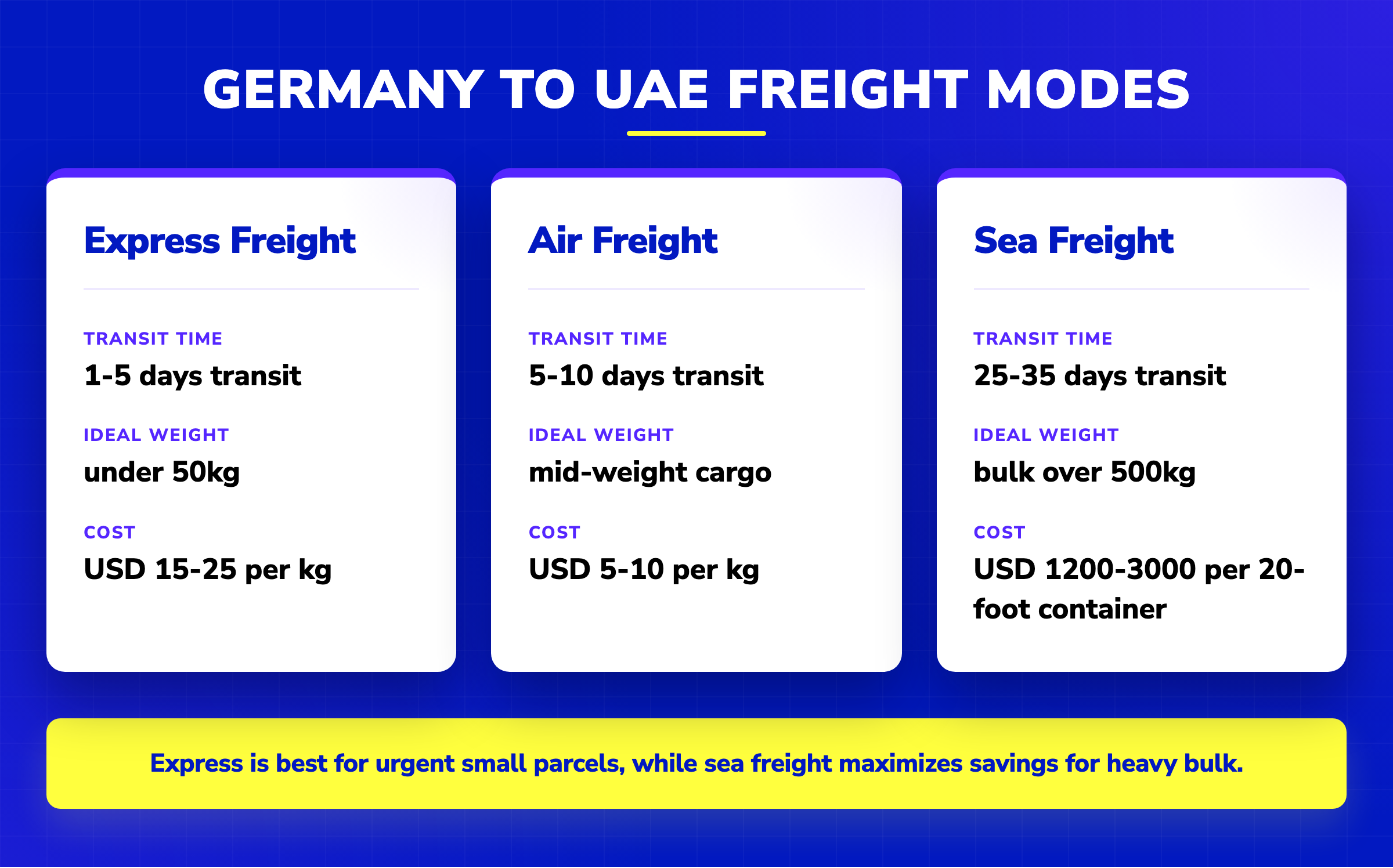
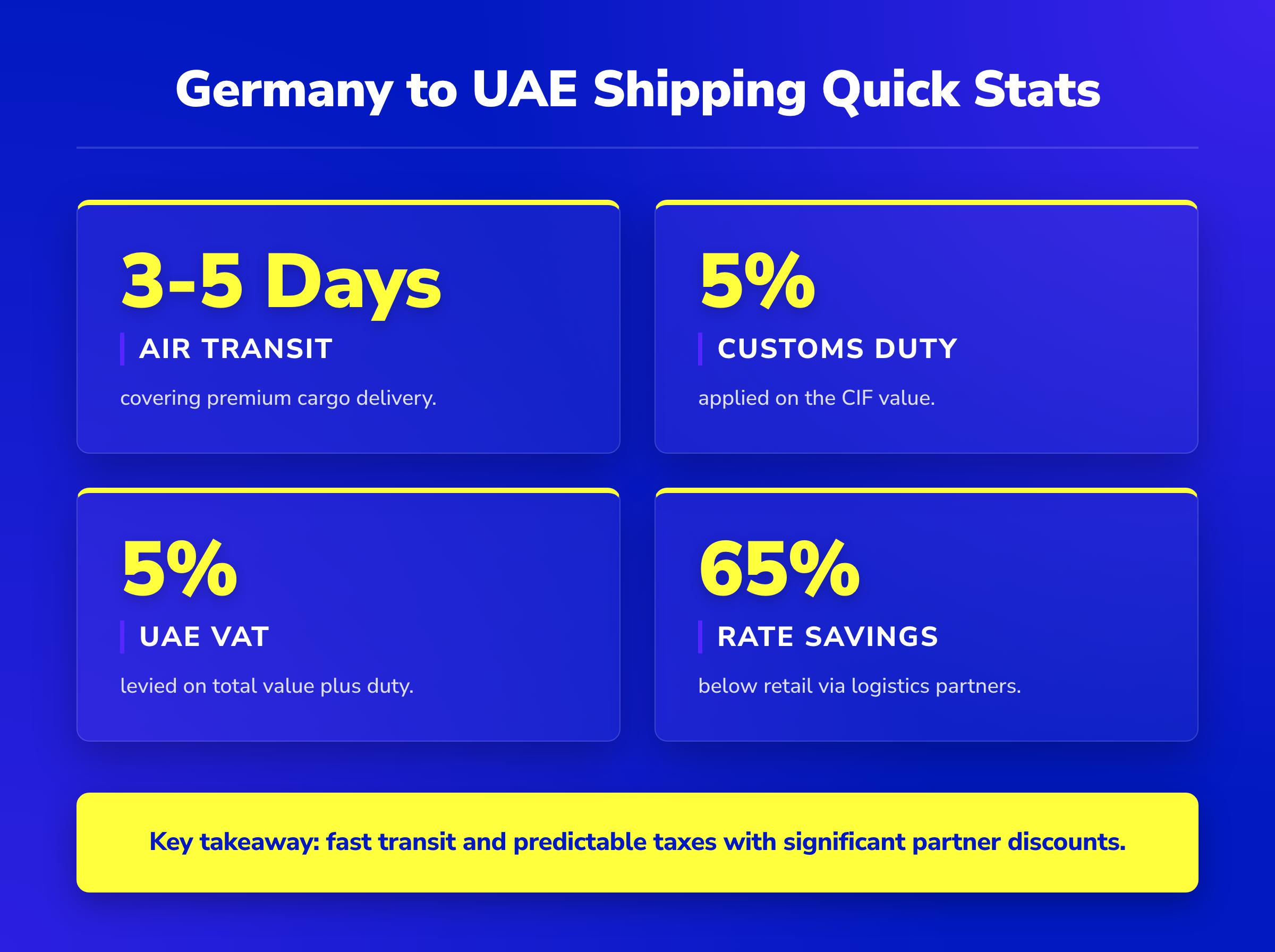
- Transit Time: Typically 5-10 days for standard door-to-door air freight, according to FreightAmigo. Premium services can reduce this to 3-5 days.
- Cost Profile: Expect rates in the range of US$5–10 per kg for standard air freight. This makes it ideal for dense, high-value goods where freight is a small percentage of the total landed cost.
When to Use Sea Freight for Bulk Shipments
Sea freight is the workhorse of global trade and the most cost-effective option for large, heavy, or non-urgent shipments. It is the default for stock replenishment and large-scale industrial projects.
- Best for: Heavy machinery, construction materials, vehicles, and high-volume consumer goods.
- Transit Time: Significantly longer, with FCL shipments taking 25-35 days port-to-port from Hamburg to Jebel Ali. LCL can take 30-45 days due to consolidation and deconsolidation processes.
- Cost Profile: Sea freight offers the lowest cost per unit. Indicative rates can range from US$1,200–$3,000 for a 20' container (FCL) or US$200–$800 per cubic metre (CBM) for LCL, as per FreightAmigo data.
When to Use Express Services for Urgent Parcels
Express logistics refers to time-critical, door-to-door services for smaller shipments, typically handled by global integrators. This mode prioritises speed and simplicity above all else.
- Best for: Urgent documents, product samples, e-commerce orders, and critical replacement parts, usually under 50 kg.
- Transit Time: The fastest option, with delivery in 1-5 business days. Some premium services can even achieve delivery within 24-72 hours, according to Eurosender.
- Cost Profile: The highest cost per kilogram, often ranging from US$15–25 per kg. The value is in the speed and fully-tracked, door-to-door service. Infinity Logistics provides access to all three modes—air, sea, and express—under a single account, allowing you to select the optimal service for each specific shipment.
A Comparison Framework: Choosing Your Mode
To make the right choice, evaluate each shipment against three core criteria:
- Urgency: How quickly does it need to arrive? If the answer is under 10 days, air or express is necessary. If you have a month or more, sea freight is viable.
- Weight & Volume: For shipments under 50 kg, express is often competitive. For shipments over 500 kg, sea freight becomes dramatically more cost-effective if time allows. Air freight serves the middle ground.
- Value Density: For a US$100,000 machine part weighing 20 kg, a US$500 express fee is negligible. For US$5,000 of raw materials weighing two tonnes, sea freight is the only economical choice.
Transit, customs & documentation
Efficient Germany to Dubai cargo movement depends on flawless execution of customs and documentation. Errors here can lead to costly delays, storage fees, and fines, negating any savings achieved on freight rates.
Typical Transit Times: Germany to UAE
Door-to-door transit times are a combination of the main leg, pre-carriage, customs clearance, and final delivery. Based on data from logistics providers like Freightos and corridor-specific guides, here are realistic timelines:
- Express: 1-5 business days
- Standard Air Freight: 5-10 business days
- Sea Freight (FCL): 25-35 days
- Sea Freight (LCL): 30-45 days
Customs clearance in the UAE typically takes 1-3 days for both air and sea, provided all paperwork is in order.
UAE Customs and VAT: What to Expect
For most commercial goods imported from Germany, the UAE's tax structure is straightforward. A logistics partner can manage this process, but it is crucial to budget for it.
- Customs Duty: A standard rate of 5% customs duty is applied to the CIF value (Cost, Insurance, and Freight) of the goods.
- Value Added Tax (VAT): A 5% VAT is then levied on the total duty-paid value (CIF value + customs duty).
Certain goods, like tobacco and alcohol, are subject to much higher excise duties. For a shipment with a CIF value of US$20,000, you should budget approximately US$1,000 for duty and US$1,050 for VAT.
The Role of Incoterms® 2020 in Allocating Costs and Risks
Incoterms® are a set of rules that define the responsibilities of sellers and buyers. Agreeing on the correct term with your German supplier is essential to avoid disputes.
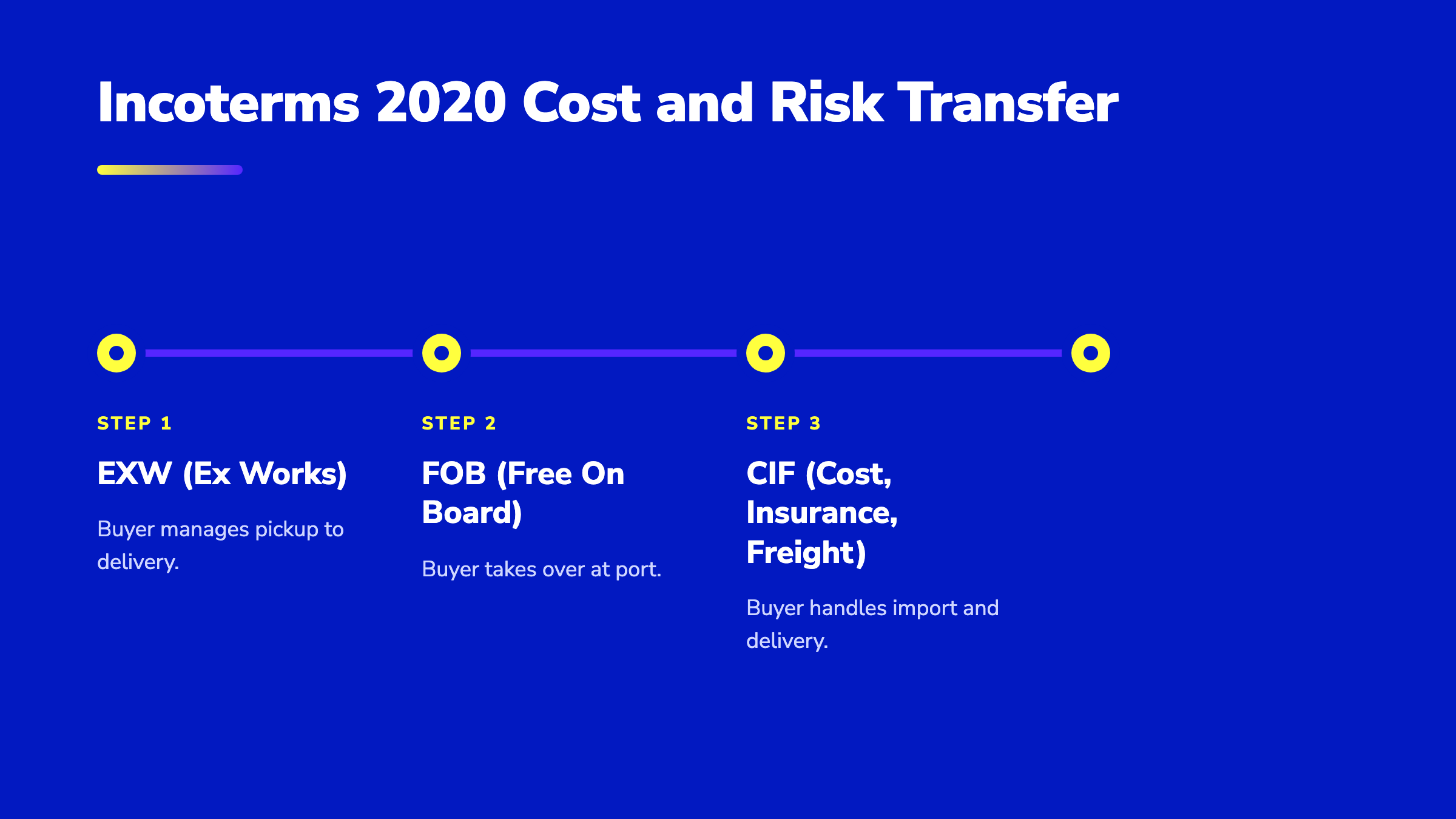
- EXW (Ex Works): Your responsibility begins at the seller's factory in Germany. You manage everything from pickup to final delivery.
- FOB (Free On Board): The seller is responsible for getting the goods to the German port of departure. You take over from there, managing the main freight, insurance, and UAE import.
- CIF (Cost, Insurance, and Freight): The seller pays for transport to Jebel Ali Port, but you are responsible for import clearance, duties, and local delivery. The CIF value is the basis for UAE customs duty.
- DDP (Delivered Duty Paid): The seller is responsible for everything, including UAE customs, duties, and final delivery. This is common in e-commerce and is often managed by a logistics partner like Infinity Logistics, which can act as the importer of record.
Essential Documentation for Smooth Clearance
Missing or inaccurate paperwork is the most common cause of customs delays. For any shipment, you will need:
- Commercial Invoice: Must detail the buyer, seller, product descriptions, HS codes, origin, and value.
- Packing List: Details the contents, weight, and dimensions of each package.
- Certificate of Origin (COO): A document issued by a German Chamber of Commerce that certifies the goods were manufactured in Germany. This is often required by UAE customs or free zone authorities.
- Bill of Lading (for sea) or Air Waybill (for air): The contract of carriage issued by the carrier.
Need a shipping quote?
Get AI-optimized rates from DHL, FedEx & UPS — up to 65% below retail. Quote in under 10 minutes.
What About the EUR.1 Certificate?
The EUR.1 movement certificate is used to claim preferential (reduced or zero) tariffs under trade agreements between the EU and other countries. However, the EU and UAE do not currently have such a free trade agreement in place. Therefore, an EUR.1 certificate does not provide any duty reduction for shipping from Germany to the UAE. The standard 5% duty rate applies.
Getting the best rate
Securing the best rate is not about finding the cheapest list price. It is about achieving the lowest total landed cost through a combination of carrier negotiation, mode optimisation, and process efficiency. This is where partnering with a tech-enabled logistics provider makes a significant impact.
Why Real-Time, Multi-Carrier Quotes are Essential
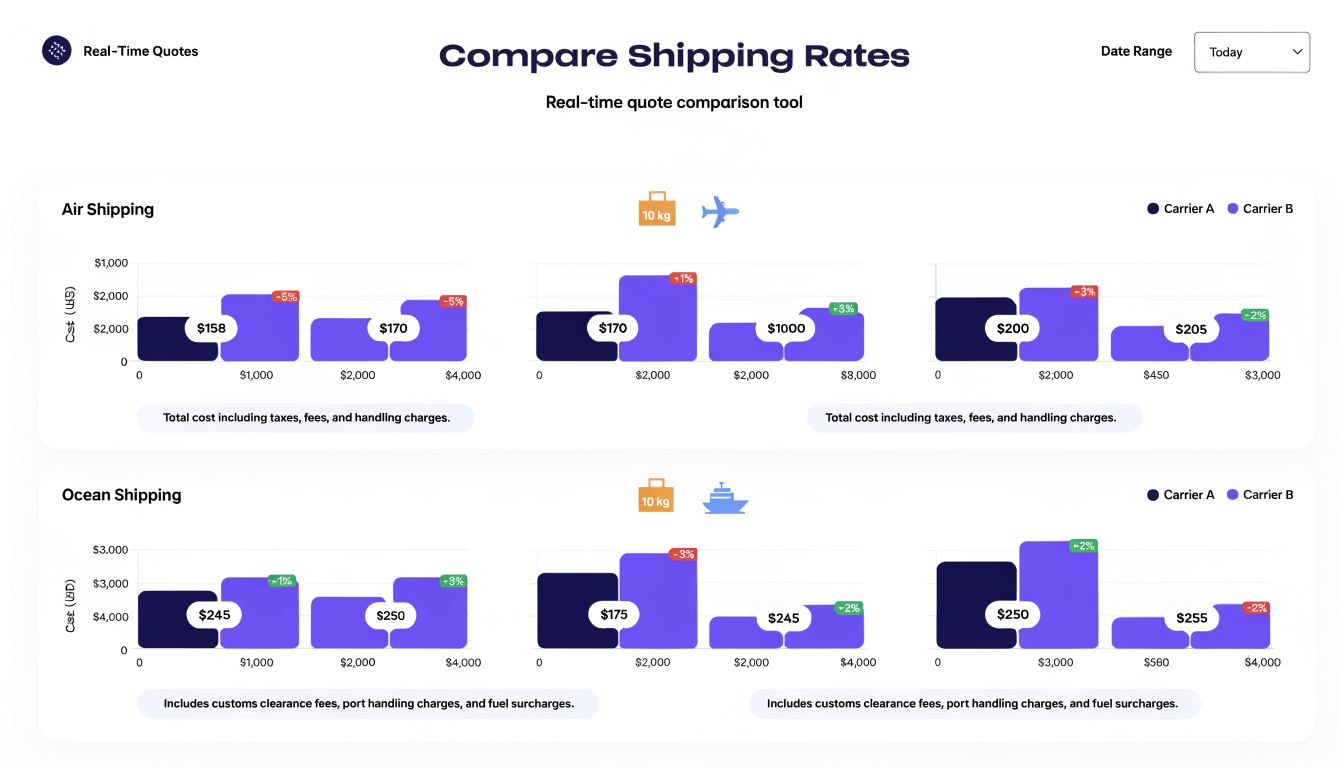
Freight rates are dynamic, changing daily based on capacity, fuel costs, and demand. Relying on static rate cards from a single carrier is a recipe for overspending. Modern logistics platforms have moved beyond this. For instance, Infinity's AI-powered platform compares rates from all major carriers in real time. This process, which returns the best option in under 10 minutes, ensures you are not leaving money on the table by defaulting to a familiar but uncompetitive option.
Benchmark Costs: Air vs. Sea on the Germany-UAE Lane
To illustrate the trade-offs, consider these 2026 benchmark costs for shipping from Germany to the UAE:
- Sea Freight (LCL): US$200–$800 per CBM
- Sea Freight (FCL 20'): US$1,200–$3,000
- Standard Air Freight: US$5–$10 per kg
- Express Courier: US$15–$25 per kg
A platform that allows you to compare these options side-by-side for each shipment enables you to make data-driven decisions, switching between modes as urgency and budget dictate.
The Impact of Surcharges and Duties on Your Final Price
The base freight rate is only part of the story. Your final invoice will include numerous other charges. FreightAmigo notes that seasonal demand can add surcharges of up to 20% in Q4. Other common additions include fuel surcharges (BAF), war risk surcharges, and terminal handling charges (THC). A transparent logistics partner will consolidate these into a clear, all-in quote, preventing unexpected costs upon delivery. This is a core principle at Infinity Logistics: One Account Manager. One Invoice. One Partner.
How Key Account Rates Deliver Significant Savings
A Key Account Centre is a volume partnership tier that grants high-frequency shippers access to pre-negotiated, preferential rates unavailable to the public. By consolidating the volume of hundreds of clients, a logistics partner can achieve this status with major carriers. Infinity Logistics is one of the few UAE enterprises that is a Top-10 volume partner with DHL, FedEx, AND UPS simultaneously. This unique position as a DHL, FedEx & UPS Key Account Centre allows us to offer our clients express shipping rates up to 65% below retail prices on the Germany to UAE route. This is how consistent shippers with 50-200 shipments per month can access pricing typically reserved for multinational corporations.
Ready to see how your rates compare? Get a real-time, no-obligation quote and discover the savings you could be making on your shipping from Germany to the UAE.
Get a Real-Time Quote
Frequently Asked Questions
What is the fastest way to ship from Germany to the UAE?
The fastest method is an express courier service. For small parcels and documents, carriers like DHL, FedEx, or UPS can deliver door-to-door from Germany to major cities like Dubai and Abu Dhabi in just 1 to 5 business days. For larger, time-sensitive cargo, premium air freight is the next fastest option, with typical transit times of 3 to 5 days.
What documents are required for shipping from Germany to the UAE?
For a smooth customs clearance process, you will need a standard set of documents. These include a detailed Commercial Invoice, a Packing List, a Certificate of Origin (COO) to prove the goods were made in Germany, and the transport document (either a Bill of Lading for sea freight or an Air Waybill for air freight). Incomplete or inaccurate paperwork is the primary cause of delays.
How are customs duties calculated for imports from Germany to the UAE?
The UAE typically applies a 5% customs duty on the CIF value of the goods. CIF stands for Cost, Insurance, and Freight, representing the total value of the goods plus the cost of shipping and insurance. After the duty is calculated, a 5% Value Added Tax (VAT) is levied on the total of the CIF value plus the duty amount.
How can I get the best shipping rates for the Germany to UAE route?
The best way to secure optimal rates is to work with a logistics partner that offers real-time, multi-carrier comparisons. Instead of being locked into one carrier's pricing, a partner like Infinity Logistics uses its high-volume Key Account status with major carriers like DHL, FedEx, and UPS to provide rates up to 65% below retail. This allows you to compare the best available options for air, sea, and express in a single quote.
What is the minimum volume to get Key Account rates with Infinity Logistics?
While there is no strict minimum, Key Account benefits are designed for businesses with regular shipping needs, typically in the range of 50 to 200 shipments per month. However, Infinity Logistics assesses each business's needs individually. We focus on consistent shipping patterns and long-term partnerships rather than a single volume threshold, so even businesses with lower but steady volumes can often benefit from our negotiated rates.
Can I ship both air and sea freight with one logistics partner?
Yes, absolutely. Using a single logistics partner like Infinity Logistics to manage all your shipping modes (air, sea, and express) is highly efficient. It provides you with a single point of contact, a consolidated invoice, and a unified view of your entire supply chain. This simplifies management and allows you to easily shift between shipping modes based on the urgency and budget of each specific shipment without needing to manage multiple vendors.
Sources & References
This article draws on research and data from the following verified sources:
- Germany Exports to United Arab Emirates2026 Data 2027 Forecast 1991-2025 Historical
- Germany (DEU) and United Arab Emirates (ARE) Trade | The Observatory of Economic Complexity
- Germany and the United Arab Emirates: Bilateral relations
- Germany and UAE trade volumes rise in 2023 | Raimundo Lopez-Lima Levi, CPA, CFF, CVA posted on the topic | LinkedIn
- Chancellor Merz's Visit to ADNOC Deepens UAE–Germany Relations
- Exports in January 2026: -2.3% on December 2025
- Shipping Cost & Delivery Time to United Arab Emirates from Germany
- Shipping from China to UAE | Dubai Cost, Time & Quote 2026
- Shipping to United Arab Emirates From Germany - MoveHub
- Shipping from Germany to the UAE - ShipHubwww.shiphub.co › shipping-from-germany-to-the-uae
- Shipping from Germany to UAE - Blue Deebaj Shipping
- Shipping services from Germany to the United Arab Emirates (2025)
- Transit Time Calculator for Sea, Air & Port To Port Shipping | Freightos
- Shipping from Germany to United Arab Emirates - GetTransport.com
- Customs Documentation Basics for Importers | FedEx Germany
- Shipping from Germany to Dubai | Transit Times & Shipping Guide ...
- Freight Forwarding &
- Shipping from Germany to UAE: A Comprehensive Guide
- E-commerce Logistics from Germany to UAE
- Shipping Cost Calculator from Germany to United Arab Emirates
- Freight Rates from Germany to United-Arab-Emirates
- Domestic prices - DHL
- Freight from Germany to UAE by Ocean & Air
- Shipping from Germany to United Arab Emirates (from Berlin to Dubai) by sea, road, rail and air freight
Related Guides
Tags
Related Articles
Ready to optimize your logistics?
Whether you need express shipping, freight forwarding, or warehousing — our AI finds the best rates and routes for your business.