
Dangerous Goods Packing & Labelling for International Shipping
A single mistake in your dangerous goods declaration can halt a million-dirham shipment. With international express volumes from the UAE growing at nearly 8% annually, the pressure on logistics managers to get DG packing right the first time has never been greater. A rejected shipment isn't just a delay; it's a cascade of re-inspection fees, carrier penalties, and lost customer trust.
This guide provides a practical, step-by-step tutorial for B2B shippers in the UAE. We will cover the mandatory requirements for UN packaging dangerous goods, labelling, and documentation to ensure your cargo is accepted, compliant, and safe. Getting this right is not optional—it is the foundation of a reliable international supply chain.
UN-specification packaging explained
UN-specification packaging is the global standard for transporting dangerous goods. It is not just any sturdy box; it is a scientifically tested and certified system. Using non-compliant packaging is one of the fastest ways to have a shipment rejected at DXB, DWC, or Jebel Ali Port. A core part of any professional dangerous goods packing services uae is the correct selection and use of this packaging.
What UN packaging codes mean
UN-specification packaging codes are a universal language. They are standardized markings that prove a package has passed rigorous performance tests mandated by the United Nations. These tests include drops, stacking pressure, and leakproofness to simulate the rigours of transport.
The code tells inspectors and carriers exactly what the packaging is made of, its performance level, and what it is certified to carry. For any business shipping internationally from Dubai, understanding this code is the first step toward compliance.
Definitional Statement: UN-specification packaging is packaging that has been designed, tested, and certified to meet the performance standards of the UN Recommendations on the Transport of Dangerous Goods. Its use is mandatory for most DG shipments to ensure safety and regulatory compliance across air, sea, and road transport.
How to read a UN specification mark
A typical UN mark, like one you would find on a fibreboard box used for combination packing, looks complex but is easy to decipher once you know the system. Let's break down an example: UN 4G/Y25/S/26/AE/XXXX
- UN Symbol: The letters "UN" in a circle or on their own. This certifies the packaging meets UN standards.
- Packaging Code (4G): The first number indicates the package type (e.g., 4 = Box), and the letter indicates the material (e.g., G = Fibreboard). So, 4G means a fibreboard box.
- Packing Group & Mass (Y25): The letter indicates the highest hazard level it's tested for:
- X: Packing Group I (high danger)
- Y: Packing Group II (medium danger)
- Z: Packing Group III (low danger)
- Content Type (S): The letter 'S' indicates the package is approved for carrying solids or inner packagings (a combination pack). If it were for liquids, this would be replaced by a density rating and hydraulic pressure test value.
- Year of Manufacture (26): The last two digits of the year it was made, in this case, 2026.
- Approval & Manufacturer (AE/XXXX): 'AE' is the country code for the approving authority (United Arab Emirates), and 'XXXX' is a unique code for the manufacturer or approval certificate.
Using a package for a substance or weight it is not certified for is a serious violation. Infinity Logistics' certified DG packers are trained to match the precise UN-rated packaging to your product's specific requirements, eliminating this risk.
Inner, outer, and absorbent requirements
For combination packagings—common in express shipments of chemicals, samples, or electronics—the relationship between inner containers, cushioning, and the outer box is critical. The UN certification applies to the entire system as it was tested.
- Inner Packaging: The bottles, cans, or plastic containers holding the substance must be compatible with it and properly sealed.
- Outer Packaging: The UN-certified box (e.g., a 4G fibreboard box) must be closed exactly as per the manufacturer's instructions. Using the wrong type or amount of tape can invalidate the certification.
- Absorbent/Cushioning: Sufficient non-reactive absorbent material must be used to soak up any potential leaks from liquid inners, and cushioning must prevent breakage.
A common failure point is using an approved outer box but with unapproved or incorrectly sized inner containers. This invalidates the entire package. Professional dg packing dubai services ensure this configuration is always correct.
Plastic packaging shelf-life considerations
A crucial but often overlooked detail is the lifespan of plastic packaging. According to UN regulations, plastic drums and jerricans have a maximum permitted service life of five years from their date of manufacture. This date is clearly marked on the UN specification code. Using a plastic drum that is even one day past its five-year expiry date will result in a non-compliant shipment, even if it appears to be in perfect condition.
Marks & labels that must appear
Once the packaging is correct, it must be communicated to everyone in the supply chain through a system of universally understood marks and labels. According to the Dubai DG Code of Practice, incorrect or missing labels are a primary reason for shipment delays at local terminals.
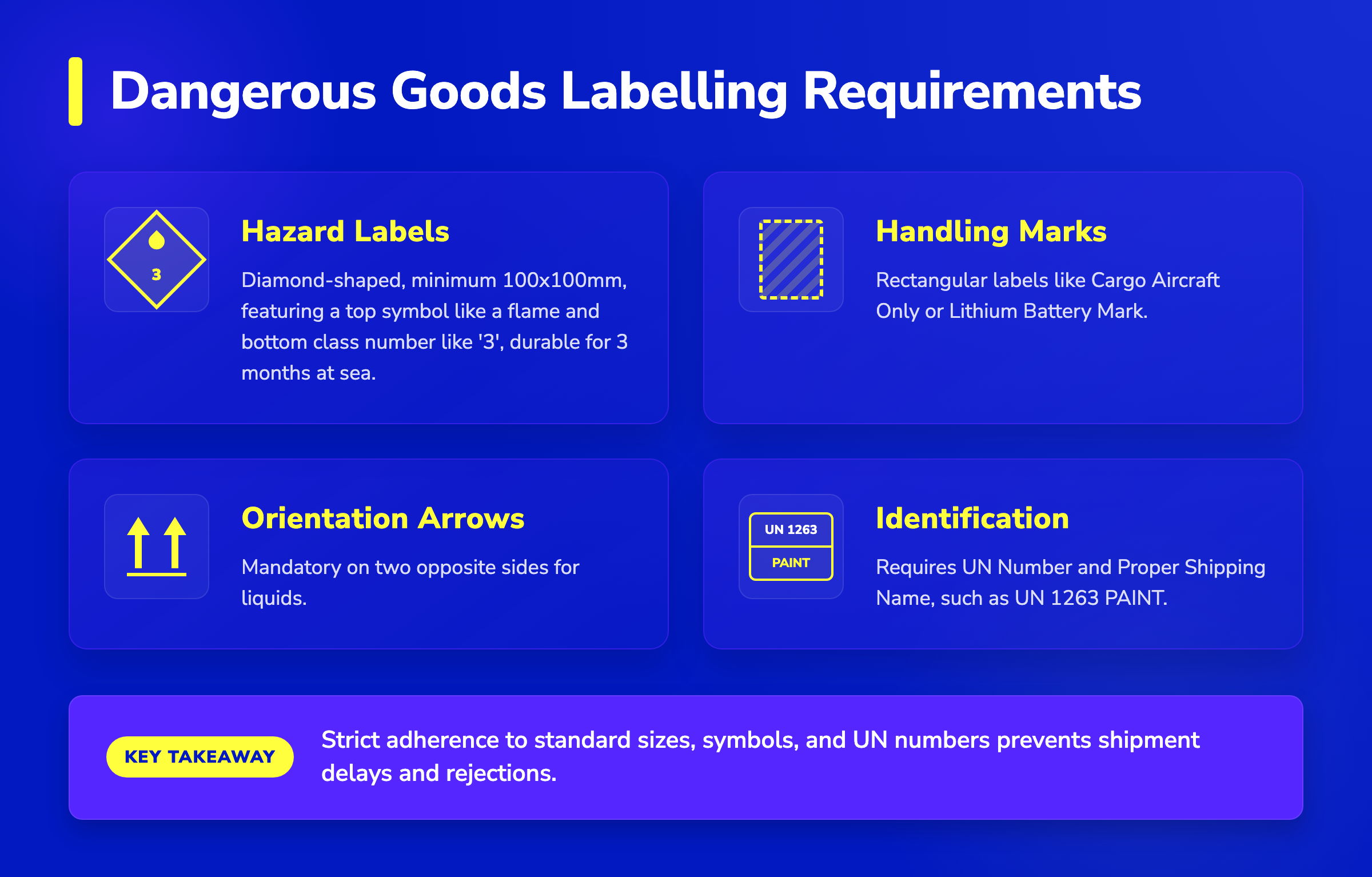
Hazard labels (diamond-shaped)
These are the most recognizable DG markings. They must be diamond-shaped (a square set at 45 degrees) and measure at least 100mm x 100mm.
- Purpose: To communicate the primary risk of the substance (e.g., flammability, toxicity, corrosivity).
- Content: The top half has a symbol (flame, skull and crossbones), and the bottom half has the hazard class number (e.g., '3' for flammable liquids).
- Subsidiary Risks: If a substance has more than one hazard (e.g., flammable and toxic), a secondary hazard label must also be applied.
These labels must be durable enough to withstand a minimum of three months at sea without fading or peeling.
Handling marks (special instructions)
These rectangular labels provide instructions for safe handling, separate from the hazard class. Common examples include:
- Cargo Aircraft Only: Mandatory for goods forbidden on passenger aircraft.
- Keep Dry / Keep Away From Heat: For environmentally sensitive substances.
- Lithium Battery Mark: A specific mark required for all shipments containing lithium cells or batteries.
As a Top-10 volume partner with DHL, FedEx, AND UPS, Infinity Logistics has direct insight into the specific handling mark requirements of each major carrier, preventing rejections at the depot.
Orientation arrows for liquids
For any combination package containing liquids, orientation arrows ("This Side Up") are mandatory. According to IATA and IMDG regulations, they must be displayed on at least two opposite vertical sides of the package. This simple mark prevents leaks caused by improper stowage and is a non-negotiable requirement for air and sea freight.
Proper Shipping Name and UN Number
Alongside the pictorial labels, every DG package must be marked with its fundamental identity:
- Proper Shipping Name (PSN): The standardized technical name of the substance (e.g., "UN 1263, PAINT"). Trade names are not permitted.
- UN Number: A unique four-digit number assigned to the substance (e.g., UN 1263).
This information must match the Shipper's Declaration exactly. Any discrepancy will be flagged during carrier acceptance checks.
The Shipper's Declaration for Dangerous Goods
The Shipper's Declaration for Dangerous Goods (DGD) is the single most important document in a DG shipment. It is a legal testament, signed by the shipper, certifying that the cargo is fully compliant with all regulations.
What it is and why it's critical
The DGD is a formal document that describes the dangerous goods in detail. It informs the carrier—whether it's Emirates SkyCargo, FedEx, or a shipping line—about the nature of the hazard, quantity, and packing method. It is the basis for their acceptance, stowage, and emergency response planning. An incorrect or incomplete DGD is not just a paperwork error; it is a safety and legal breach.
Who is legally responsible for signing?
The legal responsibility for the accuracy of the DGD lies solely with the shipper. The person signing the document must be trained and certified to do so. By signing, they declare that the consignment is "fully and accurately described... and are in all respects in proper condition for transport according to applicable international and national governmental regulations."
For many businesses, this is a significant liability. Engaging a professional dangerous goods packing services uae provider like Infinity Logistics transfers this burden to certified experts who can sign the declaration on the shipper's behalf, providing both compliance and peace of mind.
Common errors that cause shipment rejections
Carriers and regulators in the UAE are vigilant. Simple mistakes on the DGD are a leading cause of costly delays. Watch out for:

- Incorrect PSN or UN Number: Using a trade name or a slightly incorrect technical name.
- Wrong Quantities: Declaring gross weight instead of the net quantity of the dangerous substance.
- Missing Packing Group: Forgetting to specify PG I, II, or III.
- Invalid Emergency Contact: Providing a number that isn't monitored 24/7 or whose staff lack technical knowledge of the product. FedEx UAE explicitly requires a printed Shipper's Declaration with these details for most DG shipments.
- Mismatched Information: Any discrepancy between the DGD, the package labels, and the Air Waybill.
Get packing done right (or done for you)
The complexity and liability associated with DG shipping lead many UAE businesses to a critical decision: handle it in-house or outsource to an expert. While DIY may seem cheaper, the commercial impact of a single error often outweighs the cost of professional services.
When to use professional dangerous goods packing services uae
A professional service is not just for large corporations. It is a strategic choice for any business where the risk of error is high. Consider outsourcing if:
- You lack certified staff: If no one on your team holds a current IATA or IMDG certification, you cannot legally sign the DGD.
- You ship high-risk goods: Items like lithium batteries, flammable aerosols, or corrosives have complex, frequently updated rules.
- Your shipments are time-sensitive: For express freight, there is no room for the 24-72 hour delays that a DG rejection can cause.
- You ship multimodally: The rules for air, sea, and road differ. A specialist ensures compliance across the entire journey.
Infinity Logistics' AI-powered platform compares carrier options in real time, but our human expertise in DG packing & express ensures the shipment is compliant for the chosen route before it ever leaves your facility.
Need a shipping quote?
Get AI-optimized rates from DHL, FedEx & UPS — up to 65% below retail. Quote in under 10 minutes.
High-risk categories that demand expert handling
While all nine DG classes require care, some are notoriously complex. The UAE's DG warehousing market, valued at USD 1.2 billion, is driven by these challenging sectors, according to Research and Markets.
- Lithium Batteries (Class 9): With constantly changing IATA regulations (PI965-970), this is the most common source of non-compliance for electronics shippers.
- Flammable Liquids & Aerosols (Class 3 & 2.1): Require specific ventilation, segregation, and Civil Defence permits in the UAE.
- Corrosives (Class 8): Incorrect inner packaging can lead to catastrophic leaks.
Infinity Logistics provides end-to-end management for these categories, from sourcing the correct un packaging dangerous goods to securing GCAA approvals.
The cost of errors vs. the cost of expertise
The decision to use a professional service is a simple risk calculation. Consider the direct and indirect costs of a rejected DG shipment:
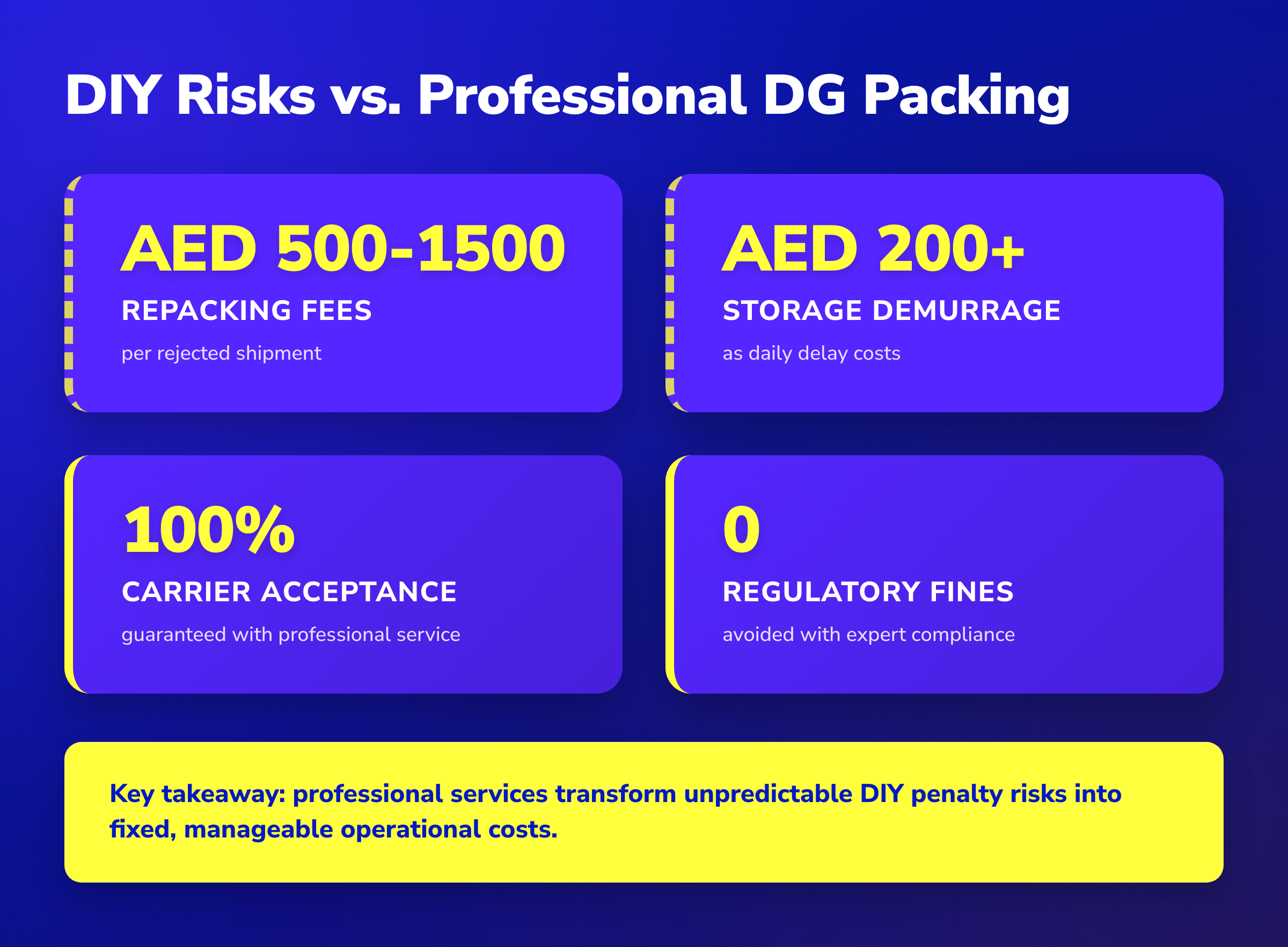
Comparison: DIY vs. Professional DG Packing
DIY Packing Risk:
- Repacking Fees: AED 500 - 1,500+ per shipment
- Storage & Demurrage: AED 200+ per day
- Carrier Penalties: Variable, can be substantial
- Delayed Delivery: Lost sales, contractual penalties
- Regulatory Fines: Potential action from GCAA
Professional Service Cost:
- A fixed, predictable fee per shipment for packing, labelling, and documentation.
- Includes liability coverage and a guarantee of carrier acceptance.
The right-first-time compliance offered by a specialist service like Infinity Logistics transforms an unpredictable risk into a manageable operational cost.
How Infinity ensures right-first-time compliance
Infinity Logistics integrates technology and human expertise to de-risk the DG shipping process. Our approach is built on a foundation of "One Account Manager. One Invoice. One Partner," simplifying complexity for our clients.
- Expert Verification: Your dedicated Account Manager, backed by IATA-certified DG specialists, reviews your product's Material Safety Data Sheet (MSDS) to confirm its classification.
- Correct Packaging & Labelling: We select the precise UN-certified packaging and apply all required hazard and handling labels, ensuring full compliance with IATA and IMDG codes.
- Compliant Documentation: We prepare and sign the Shipper's Declaration for Dangerous Goods, taking on the legal responsibility and ensuring all documents are flawless.
- Carrier Optimisation: As a Key Account Centre with Top 10 volume partner status across DHL, FedEx, and UPS, we navigate each carrier's specific DG rules and secure rates up to 65% below retail, helping offset DG surcharges. Our AI agents return the best compliant carrier option in under 10 minutes.
This structured process, verified by our WCA (World Cargo Alliance) membership, is why hundreds of UAE businesses trust Infinity with their most critical DG shipments.
Don't let dangerous goods regulations disrupt your supply chain. Partner with an expert who guarantees compliance from the start. Get a Real-Time Quote from Infinity Logistics and ship with confidence.
Frequently Asked Questions
What is UN-specification packaging?
UN-specification packaging is a system of containers (boxes, drums, jerricans) that have been built, tested, and certified to meet performance standards set by the United Nations. These standards ensure the packaging is strong enough to withstand the typical rigours of shipping without leaking or breaking. Each certified package bears a UN mark that details its type, material, performance level, and year of manufacture. Using UN-spec packaging is mandatory for most international dangerous goods shipments.
What are the 9 classes of dangerous goods?
Dangerous goods are categorized into nine classes based on the primary type of hazard they present. A professional dg packing dubai service will be familiar with all of them:
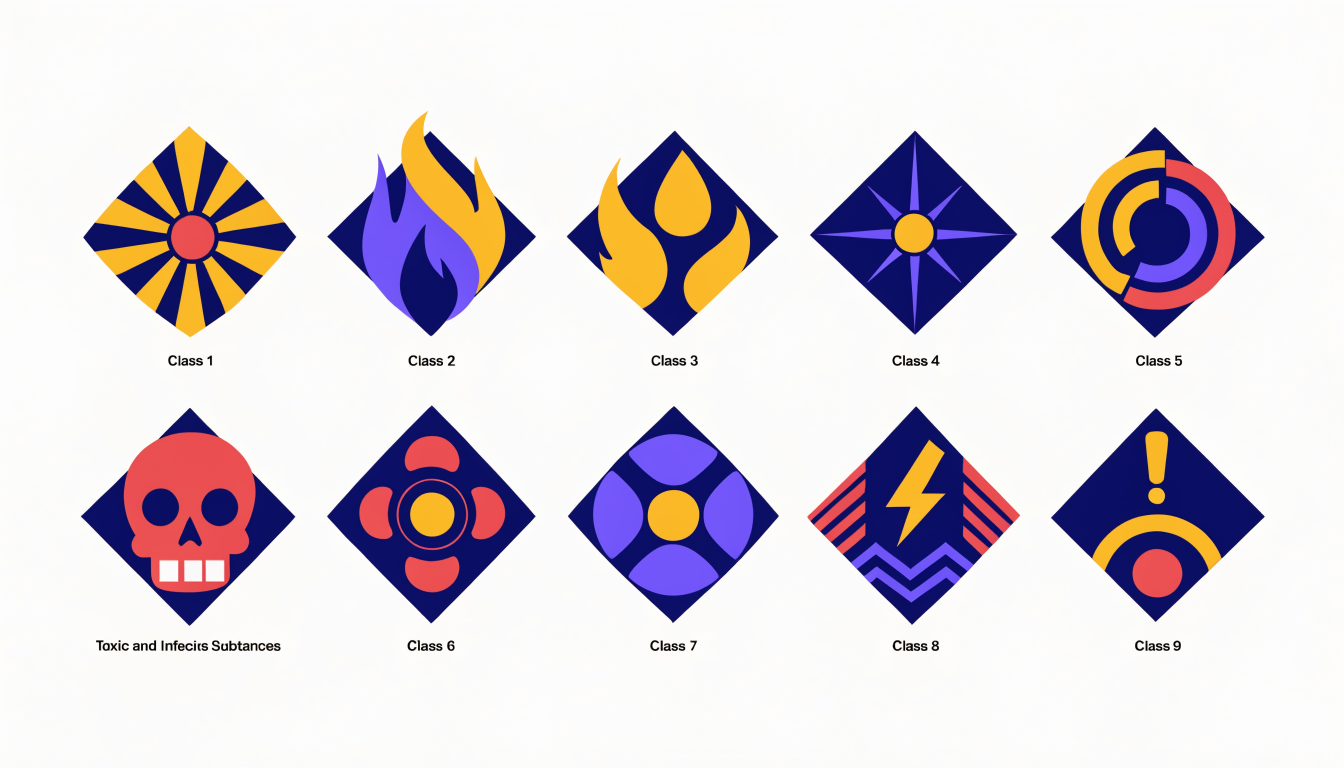
- Class 1: Explosives
- Class 2: Gases (flammable, non-flammable, toxic)
- Class 3: Flammable Liquids
- Class 4: Flammable Solids; Spontaneously Combustible; Dangerous When Wet
- Class 5: Oxidizing Substances & Organic Peroxides
- Class 6: Toxic & Infectious Substances
- Class 7: Radioactive Material
- Class 8: Corrosive Substances
- Class 9: Miscellaneous Dangerous Goods (e.g., lithium batteries, dry ice)
Can I reuse a UN-certified box?
You can reuse a UN-certified box, but only under strict conditions. The box must be in excellent condition with no damage, punctures, or water damage. All old, irrelevant labels must be completely removed or obliterated. Most importantly, it can only be reused for the same or a similar product, using the exact same inner packaging and closing method it was originally certified with. For liability and compliance reasons, most professional dangerous goods packing services uae recommend using a new box for every shipment.
What should I look for in a dangerous goods packing service in the UAE?
When choosing a DG packing partner, look for these key attributes:
- Certifications: Staff must hold current IATA and IMDG certifications to legally handle and declare DG shipments.
- Experience: They should have proven experience with your specific product type (e.g., lithium batteries, chemicals).
- Comprehensive Service: The service should include sourcing UN packaging, packing, labelling, and preparing/signing the Shipper's Declaration (DGD).
- Carrier Relationships: Strong partnerships with carriers like DHL, FedEx, and UPS ensure they understand carrier-specific rules and can help resolve issues quickly.
- Reputation: Look for memberships in global networks like WCA (World Cargo Alliance), which vets forwarders for quality and reliability. Infinity Logistics meets all these criteria.
How does Infinity Logistics handle lithium battery shipments?
Infinity Logistics has a specialized process for lithium batteries (UN3480, UN3481, etc.). Our IATA-certified team first verifies the battery type, watt-hour rating, and whether it's packed with or contained in equipment. We then select the correct UN-specification packaging and apply all required markings, including the Class 9 hazard label and the lithium battery mark. We prepare the Shipper's Declaration according to the correct IATA Packing Instruction (e.g., PI965, PI967), ensuring full compliance and preventing costly rejections by airlines.
What is the minimum volume to get preferred DG shipping rates?
There is no fixed minimum volume. Preferred rates are typically based on consistent shipping frequency and overall spend. However, by using a service like Infinity Logistics, businesses of all sizes can access our preferential rates immediately. As a Top-10 volume partner with DHL, FedEx, and UPS, we leverage our aggregate volume to offer all our clients express rates up to 65% below retail, even for single DG shipments. Our AI-powered platform automatically finds the best rate for your specific shipment in minutes.
Sources & References
This article draws on research and data from the following verified sources:
- UN Specification Packaging Codes | Hazmat University
- What are UN Specification Marks and how to read them?
- UN Package Markings Explained 4G / Y 24.7 / S / 2024 ...
- UN Packaging & Dangerous Goods Packaging Marking Guide
- UN Specification Marking: “S” vs “S” - ICC Compliance Center
- FAQs | Galaxypacs
- UN specification packaging
- How to Read UN Packaging Markings - C.L. Smith
- Description of United Nations Packaging Marks
- UAE Dangerous Goods Regulations Guide | DG Shipping ...
- Dangerous Goods & Cargo Compliance | SGS United Arab Emirates
- Dangerous Goods Labels - ANA Cargo
- PCFC-TRK-EHS-PM-REG-11 Regulation PM-11.0 - Dangerous Goods
- How to Ship | Dangerous Goods | FedEx United Arab Emirates
- [PDF] Dangerous Goods - in the Emirate of Dubai - WKC Group
- [PDF] Dangerous Goods Shipper's Declaration fillable form - IATA
- Dangerous Goods - Emirates SkyCargo
- The Essential Guide to Shipper's Declaration for Dangerous Goods
- [PDF] Guidance for Completing the Shipper's Declaration for Dangerous ...
- GCC Dangerous Goods Logistics Market Size & Share Analysis
- Dangerous Goods - Sasco Global Logistics
- UAE Dangerous Goods Warehousing (HF, Aerosols, Lithium) Market ...
- Dangerous Goods Packing - Dubai - City Moon Cargo LLC
- International Express Delivery Market Size Report 2025-2030
- International Courier Market Analysis, Size, and Forecast 2026-2030
- Global Logistics Market Size, Share, Growth & Trends, 2034
- UAE Logistics Market Size, Share & Trends Forecast 2034
- International Express Delivery Market Size | Industry Report, 2034
Related Guides
Tags
Related Articles
Ready to optimize your logistics?
Whether you need express shipping, freight forwarding, or warehousing — our AI finds the best rates and routes for your business.